Dear Members,
I am very new to field of nanoindentation and my question might appear too simple.
I am indenting an elastic - plastic material (polymer blend) with spherical indenter. I am well verse with hertz contact mechancis theory and indentation theories like Oliver & Pharr, JKR, DMT and few others.
I have with me Load Vs Indentation depth data from my instrument. To apply Oliver and Pharr analysis, I am suppose to use the intial unloading part of the curve to get the slope. But, how one decides from which point one should draw the slope line?? I have refered to many articles, where in they show slope line drawn directly to their unloading curve, but don't describe the actual procedure how do they do it. Also any error is slope will directly influence you measurement and will spread your calculated young's modulus.
Can anyone comment on this problem. Any reference to publication will also be of great help.
Best....
Nirav
| Attachment | Size |
|---|---|
| Oliver & Pharr.JPG | 48.56 KB |
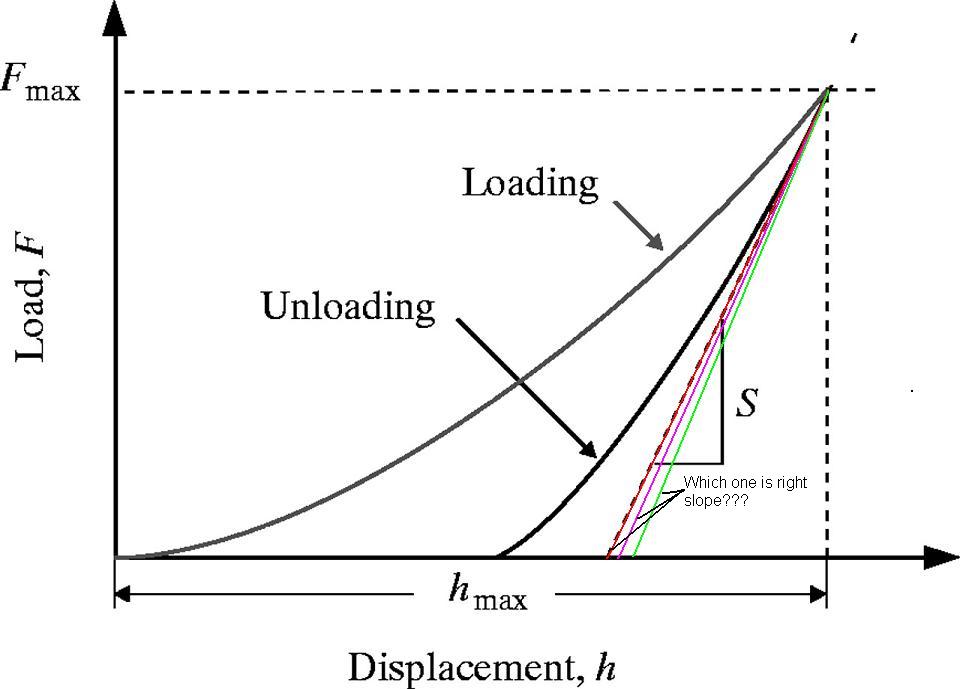
Region of Interest in Oliver-Pharr Analysis
Hi Nirav,
The method is clear that that stiffness S (slope) must be calculated at the maximum force (Fmax). Now Stiffnesss S is computed from the force vs depth fit and you have to provide a range (of force) for that fit, as you describe. The literature recommends a fit in the region [0.1, 0.9] Fmax (Fmax = Maximum force) for ceramics and low creep metals, and [0.25, 0.65] Fmax for polymers like it is your case.
To make it more rational for polymers, I recommend you indent with a method that measures creep so that you verify experimentally that creep is not a significant or dominating effect during the unload cycle in which you intend to perform the computation.
The reason for this range has been discussed in the literature, however, ultimately there are unanswered questions about the physics. The Oliver-Pharr method is a reference material method, so provided you have a good reference material to determine the area function, then you minimize your error propagation.
Hope this helps,
Flavio Alejandro Bonilla
In reply to Region of Interest in Oliver-Pharr Analysis by Flavio A. Bonilla
Thanks and a question...
Dear Flavio Alejandro Bonilla,
I almost lost hope that anyone will reply to my post and never checked it back on forum. Thank you very much for your reply. I have made a set of some polymer blends (PDMS 10:1 and 20:1) which I use them as refrence materials for characterization, but, unavability of good standard refrence material does still remain.
I have one more question. I perform indentation of my PDMS 10:1 and 20:1 using my cantilever probe with spherical tip and certain stiffness. Using Oliver and Pharr i find the sample modulus (e.g. PDMS 10:1 - 4.3 MPa; 20:1 - 1.4 MPa). But any error i make is calculating the stiffness of my cantilever will be also propagated to my calculated sample modulus (Load = Cantilever stiffness*Cantilever deflection) ....RIGHT??? In that case the ratio of modulus measured should cancel out the error of cantilever stiffness and it will give us the relative stiffness of two samples meaured by the sample cantilever. I call this ratio of moduls measured as modulus ratio. But I havent come across literature which refers to calculation of such ratio of modulus. Can you please comment if this modulus ratio is a good way to relatively characterize samples (offcourse when measured with same cantilever!)
Looking forward to your comment.
Best,
Nav