hi im modeling submerged cylinder subjected to underwater explosion.
this paragraph is related to example of Abaqus in Documentaion.
what is the meaning and concept of this paragraph (Addess mass):
i attached the image of paragraph text.
i appreciate your kind helps :)
tnx
"9.1.3 RESPONSE OF A SUBMERGED CYLINDER TO AN UNDERWATER EXPLOSION
SHOCK WAVE"
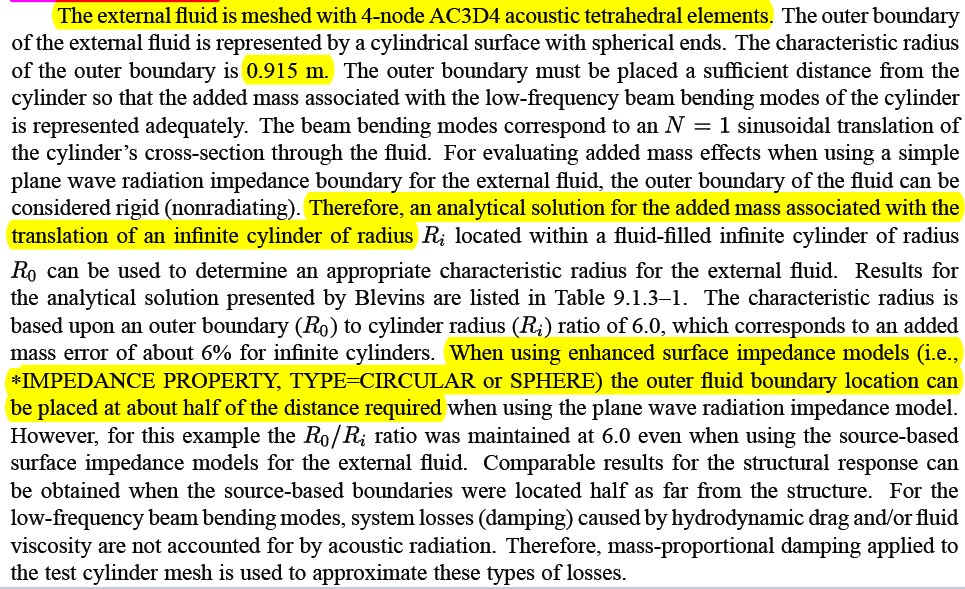
The external fluid ismeshed with 4-node AC3D4 acoustic tetrahedral elements. The outer boundary
of the external fluid is represented by a cylindrical surface with spherical ends. The characteristic radius
of the outer boundary is 0.915 m. The outer boundary must be placed a sufficient distance from the
cylinder so that the added mass associated with the low-frequency beam bending modes of the cylinder
is represented adequately. The beam bending modes correspond to an sinusoidal translation of
the cylinder’s cross-section through the fluid. For evaluating added mass effects when using a simple
plane wave radiation impedance boundary for the external fluid, the outer boundary of the fluid can be
considered rigid (nonradiating). Therefore, an analytical solution for the added mass associated with the
translation of an infinite cylinder of radius located within a fluid-filled infinite cylinder of radius
can be used to determine an appropriate characteristic radius for the external fluid. Results for
the analytical solution presented by Blevins are listed in Table 9.1.3–1. The characteristic radius is
based upon an outer boundary ( ) to cylinder radius ( ) ratio of 6.0, which corresponds to an added
mass error of about 6% for infinite cylinders. When using enhanced surface impedance models (i.e.,
*IMPEDANCE PROPERTY, TYPE=CIRCULAR or SPHERE) the outer fluid boundary location can
be placed at about half of the distance required when using the plane wave radiation impedance model.
However, for this example the ratio was maintained at 6.0 even when using the source-based
surface impedance models for the external fluid. Comparable results for the structural response can
be obtained when the source-based boundaries were located half as far from the structure. For the
low-frequency beam bendingmodes, system losses (damping) caused by hydrodynamic drag and/or fluid
viscosity are not accounted for by acoustic radiation. Therefore, mass-proportional damping applied to
the test cylinder mesh is used to approximate these types of losses.
| Attachment | Size |
|---|---|
| Added mass.jpg | 253.61 KB |
Re: Added mass
That's the extra inertial mass of the fluid being displaced.
Good descriptions can be found in books on fluid dynamics and marine design.
For example, Johnson's "The Handbook of fluid dynamics" says
"When a body is accelerated in an ideal compressible fluid, the force required for a given acceleration is greater than that for the same body acclelerating in avacuum. This is because the force must also accelerate the fluid surrounding the body. ...."
-- Biswajit