C. Cissé and M. Asle Zaeem. On the elastocaloric effects in CuAlBe shape memory alloys: A quantitative phase-field modeling approach. Computational Materials Science 183 (2020) 109808 (12 pages).
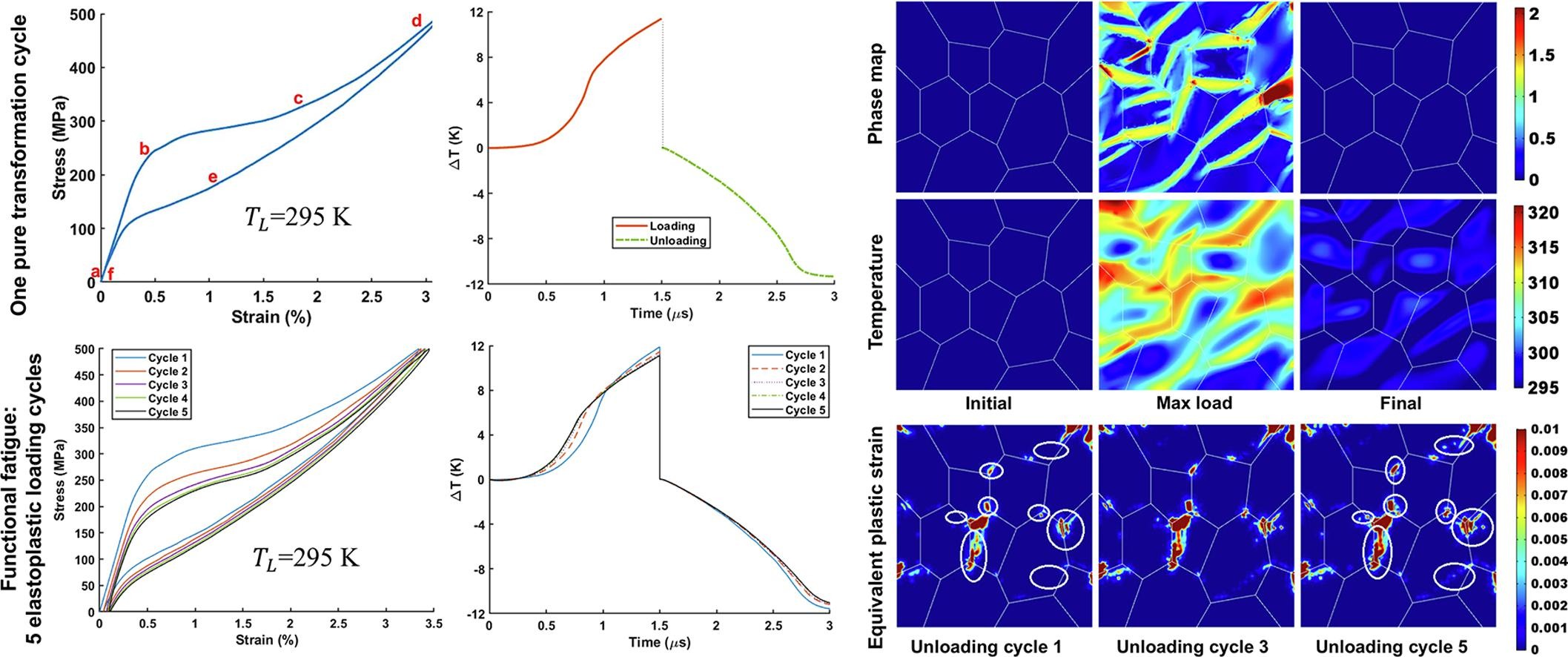
The reversible stress-induced phase transformation in shape memory alloys (SMAs) is a dissipative process during which heat is absorbed or released. The inherent temperature variations inside the material has an elastocaloric effect (eCE) with appealing applications in solid-state cooling technology such as compact and efficient on-board refrigeration system for eletronic devices. In this manuscript, we conduct the first study of eCE of CuAlBe SMAs utilizing phase-field modeling. For an applied stress of 500 MPa, the results for polycrystalline Cu-Al11-2Be (at. %) show a minimum adiabatic unloading temperature change of −10 K over a pseudoelastic window of 40 K. In the absence of plastic deformation, the material demonstrates good reproducibility of the eCE over a few loading–unloading cycles. The presence of plastic deformation is found to cause functional fatigue that deteriorates the cooling capacity; however, the coefficient of performance only decreases from 9.04 to 8.03, which is still a very good value. These results place CuAlBe as a frontrunner SMA for solid-state cooling compared to the expensive NiTi.
Download from here: On the elastocaloric effects in CuAlBe shape memory alloys: A quantitative phase-field modeling approach.
| Attachment | Size |
|---|---|
| Elastocaloric Effects by Phase-Field Modeling | 286.98 KB |