Dear iMechanica community,
Scientific Machine Learning (SciML) combines scientific knowledge, mathematical models, and data to address scientific and engineering problems. For the mechanics community, potential applications include predicting thermal and mechanical fields, identifying material parameters from measurements, and developing fast surrogates for expensive numerical simulations.
Methods such as physics-informed neural networks (PINNs) and neural operators provide different ways to explore these applications. However, translating a well-defined physical problem into a working implementation can require substantial programming effort.
A researcher may understand the governing equations, constitutive relations, and boundary conditions, yet face challenges implementing automatic differentiation, constructing loss functions, configuring neural networks, and organizing training routines. This creates a practical gap between domain expertise and access to SciML tools.
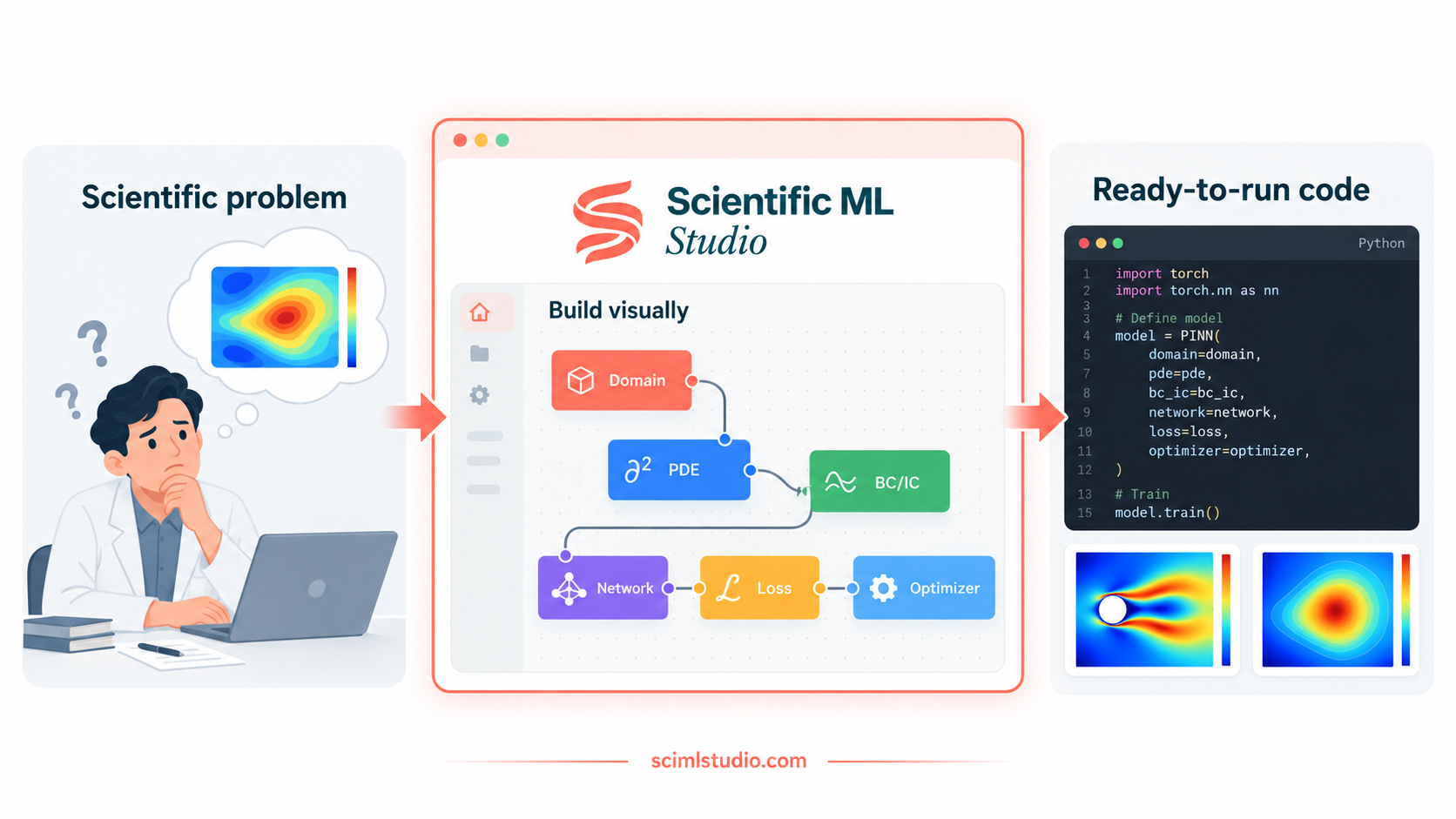
To help address this gap, my cofounder and I have developed SciML Studio, a visual, block-based environment for configuring models and generating code.
As illustrated in the accompanying figure, users assemble their model by connecting blocks representing the domain, governing equations, boundary and initial conditions, neural network, loss functions, and optimizer. Compatibility checks and configuration guidance assist with model setup.
The initial release focuses on PINNs and PyTorch code generation. Users can download the generated code, run it in their own environment, inspect the implementation, and modify it for further development. Training currently takes place outside the website.
Our aim is to reduce repetitive implementation work and make PINN experimentation more accessible to researchers, educators, and students with different levels of programming experience. Physical formulation, training choices, and validation remain central to obtaining meaningful results.
Explore the initial version: https://scimlstudio.com/
We would welcome feedback from the iMechanica community on the workflow, generated code, and features needed for mechanics applications. Which problem types or capabilities would make this tool useful in your research or teaching?
| Attachment | Size |
|---|---|
| Scientific ML Studio Workflow.png | 1.27 MB |