31st July 2026, 1:00 PM - 2:00 PM (CDT)
Meeting ID: 824 6447 8256 | Passcode: 003801
Physical Mechanisms of Blast-induced Large Deformations in Brain-like Soft Matter
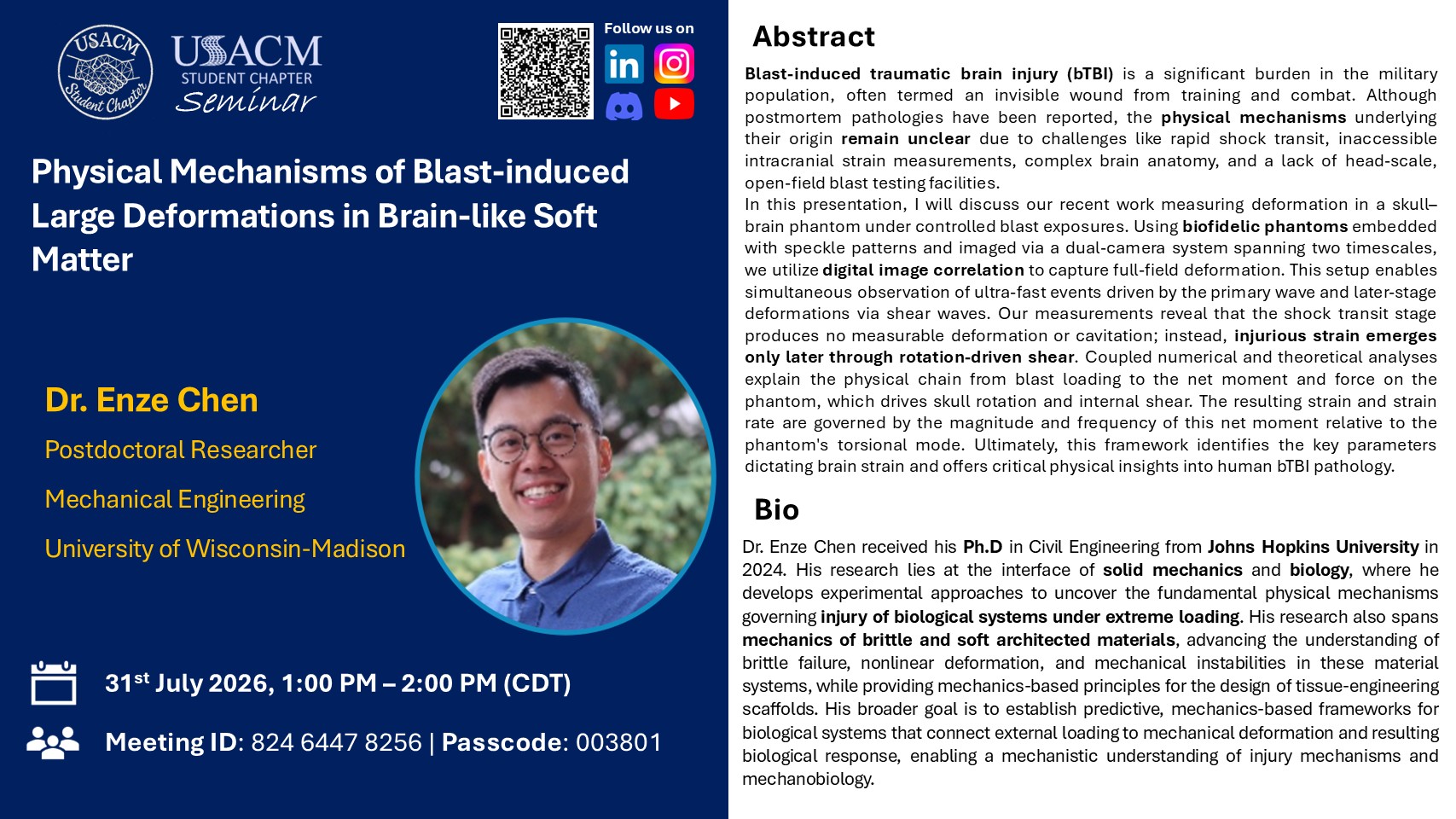
Dr. Enze Chen, Postdoctoral Researcher in Mechanical Engineering, University of Wisconsin-Madison
Abstract
Blast-induced traumatic brain injury (bTBI) is a significant burden in the military population, often termed an invisible wound from training and combat. Although postmortem pathologies have been reported, the physical mechanisms underlying their origin remain unclear due to challenges like rapid shock transit, inaccessible intracranial strain measurements, complex brain anatomy, and a lack of head-scale, open-field blast testing facilities.
In this presentation, I will discuss our recent work measuring deformation in a skull-brain phantom under controlled blast exposures. Using biofidelic phantoms embedded with speckle patterns and imaged via a dual-camera system spanning two timescales, we utilize digital image correlation to capture full-field deformation. This setup enables simultaneous observation of ultra-fast events driven by the primary wave and later-stage deformations via shear waves. Our measurements reveal that the shock transit stage produces no measurable deformation or cavitation; instead, injurious strain emerges only later through rotation-driven shear. Coupled numerical and theoretical analyses explain the physical chain from blast loading to the net moment and force on the phantom, which drives skull rotation and internal shear. The resulting strain and strain rate are governed by the magnitude and frequency of this net moment relative to the phantom's torsional mode. Ultimately, this framework identifies the key parameters dictating brain strain and offers critical physical insights into human bBI pathology.
Bio
Dr. Enze Chen received his Ph.D in Civil Engineering from Johns Hopkins University in 2024. His research lies at the interface of solid mechanics and biology, where he develops experimental approaches to uncover the fundamental physical mechanisms governing injury of biological systems under extreme loading. His research also spans mechanics of brittle and soft architected materials, advancing the understanding of brittle failure, nonlinear deformation, and mechanical instabilities in these material systems, while providing mechanics-based principles for the design of tissue-engineering scaffolds. His broader goal is to establish predictive, mechanics-based frameworks for biological systems that connect external loading to mechanical deformation and resulting biological response, enabling a mechanistic understanding of injury mechanisms and mechanobiology.
| Attachment | Size |
|---|---|
| Seminar-flyer-Enze-Chen.jpg | 463.83 KB |