http://dx.doi.org/10.1016/j.ijfatigue.2008.03.004
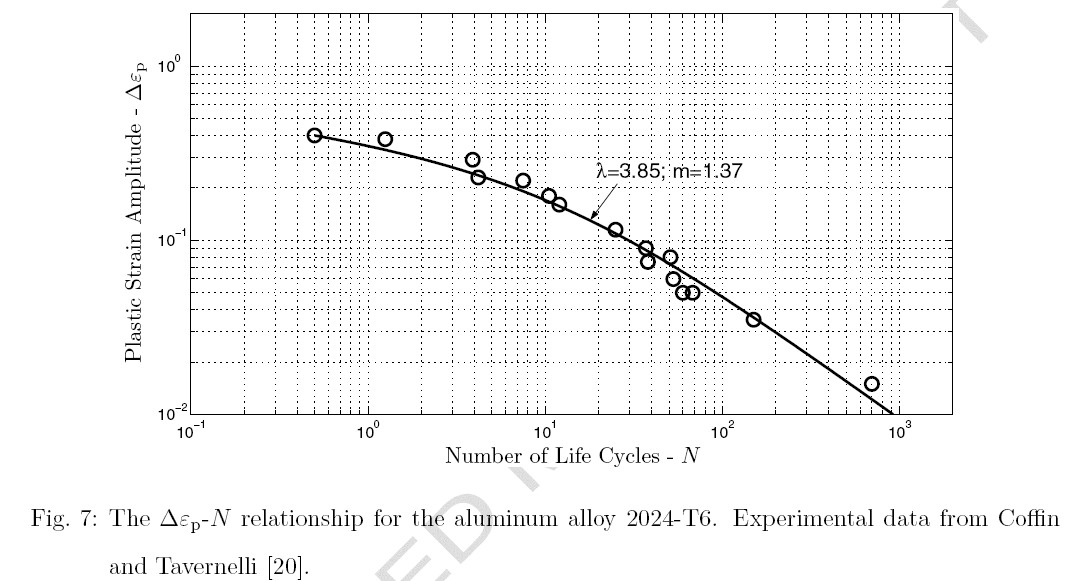
It is well-known that the empirical Manson-Coffin law tends to over-predict the cyclic life under
extremely low cycle fatigue condition. In the present paper, a new unified expression is proposed to
overcome this shortcoming. By introducing an exponential function, this new expression is capable
of capturing the cyclic life over the entire span of extremely low cycle fatigue to low cycle fatigue
with an additional material parameter to calibrate. Experimental data from existing literature are
used to demonstrate the applicability of the proposed expression for several polycrystalline metals.
The implication of the new expression to monotonic plastic fracture is discussed. It is also identified
that the exponent in the unified expression is sensitive to temperature. Examples are given for the
thermal influence on the material constants.
Keywords: Damage accumulation; Damage plasticity theory; low cycle fatigue; extremely low cycle
fatigue; ductile fracture.
| Attachment | Size |
|---|---|
| e_n.jpg | 170.37 KB |
Stiffness reduction
IS there any paper which deals with stiffness reduction in materials in cyclic loading case such that the work has only purely theoretical bases.
why do we really care?
extremely low cycle fatigue condition means few cycles? And what is the application?
In reply to why do we really care? by Mike Ciavarella
Mike, Yes, you are right,
Mike, Yes, you are right, the so-called "Extremely low cycle fatigue" or sometimes called "Ultra low cycle fatigue" means those load conditions that reverve very few times before the material breaks, say typically less than 20 cycles. It is a narrow region where fair amount of plasticity is observed in
each cycle - it lies between simple single stroke tests and low cycle
fatigue where plasticity is very small in each cycle.
In real life, this usually means you will have to load the material to somewhere above 1% strain for ductile metals. Bend the handle of a brass tea spoon for a few times, you can see the deformation localizes and then breaks. In earthquakes, you may also observe catastropic failures due to only several cycles of reversed loadings. It is just a measurement of how many cycles of the fatigue life. Find a less ductile material, if it fails in the low cycle fatigue range (say 20-1000 cycles), it may break just in the extremely low cycle range. To modelers, it may mean as simple as the Manson-Coffin law does not hold and the single stroke failure comes more or less into play. Usually, this means, the log-log plot bends towards the origin as the life cycles decreases.
In reply to Mike, Yes, you are right, by Liang Xue
it may be treated just as a crossover
looking at your figure, it seems you have a sligth deviation from power law. It may be just a transition from the static value to the power law regime. You call this type of transition, a crossover, and it is easy to derive empirical equations.
For example, if you have a fatigue limit for 1/4 cycle, or loosely speaking 0 cycles, and this is sigma_lim, and you have fatigue threshold at large a, you can derive an equation of the El Haddad type sigma Sqrt (a+a0) = DK_th. where a0 is defined by sigma_lim Sqrt (a0) = DK_th.
In your case, you may identify a transition for number of cycles, N0, and apply static value for N<N0 and Coffin-Manson above. Or else derive a crossover equation. No need to think about.
In reply to it may be treated just as a crossover by Mike Ciavarella
Mike, the aim is to link
Mike, the aim is to link the single stroke to reverse loading case using a simple relationship, as I see there is a gap between the extension of Manson-Coffin law to a single stroke fracture, instead of separating the life curve into several segments and say each is governed by such and such law. That is what I did in my paper. I am happy with the relationship so far as it introduced only one additional parameter to fit the curve. Of course, other relationships are possible.
But I think you are mixing crack advancing with the initiation of fracture here. The crack length is not my concern here.
In reply to Mike, the aim is to link by Liang Xue
dear Liang, I am not "mixing", I am trying to make "parallels"
Michele Ciavarella, Politecnico di BARI - Italy, Rector's delegate.
http://poliba.academia.edu/micheleciavarella
is there ratchetting?
Michele Ciavarella, Politecnico di BARI - Italy, Rector's delegate.
http://poliba.academia.edu/micheleciavarella
ratchetting is certainly possible
depends on how you load it. Idealy, a perfect cycle is used for these tests.
I didn't read the paper, but I would think that...
If a material has a limit strain, exhaustion of ductility, then there is a transition from this static limit, to the fatigue situation. Coffin-Manson is just a simplified power law equation, there is no fundamental physics behind it. Power laws emerge often in physics, but sometimes for very hidden reasons. The only case where they are fundamental is what Barenblatt calls "complete self-similarity", when Buckingham theorem dominates the problem, and you can extract the powers from simple dimensional analysis. This is not the case of Coffin-Manson, hence I am not surprised. You may find it useful to read a related question on Paris law, in
One, no one, and one hundred thousand crack propagation laws: A generalized Barenblatt and Botvina dimensional analysis approach to fatigue crack growth Original Research Article
Journal of the Mechanics and Physics of Solids, Volume 56, Issue 12, December 2008, Pages 3416-3432
Michele Ciavarella, Marco Paggi, Alberto Carpinteri
Hope this helps. Mike
Manson-Coffin relationship is an empirical relationship
Manson-Coffin relationship is an empirical relationship on initiation of fracture due to cyclic plastic loadings. It is so simple and useful. You cannot ask too much about it. Indeed, a large number of relationships are phenomenological (or derived from some sort of phenomenological models) - it is about description - and hence useful. Kirchhoff has something similar may better wording than me. I cannot recall exactly what he said in a letter.
Thank you for referening the paper - I am interested in it and hope I will find some time to read it.
I suggest you also this paper by Johnson and Kapoor
http://onlinelibrary.wiley.com/doi/10.1111/j.1460-2695.1994.tb00801.x/abstract
A RE-EVALUATION OF THE LIFE TO RUPTURE OF DUCTILE METALS BY CYCLIC PLASTIC STRAIN
Article first published online: 2 APR 2007
DOI: 10.1111/j.1460-2695.1994.tb00801.x
Issue
Fatigue & Fracture of Engineering Materials & Structures
Volume 17, Issue 2, pages 201–219, February 1994
Additional Information(Show All)
How to CiteAuthor InformationPublication History
Now at the Engineering Dept., University of Leicester, Leicester LE1 7RH, U.K.
SEARCH
ARTICLE TOOLS
Abstract— Experiments have been performed on specimens subjected to strain cycles similar to those experienced by sub-surface elements of material in rolling/sliding contact. It has been observed that if the strain cycle is closed then failure takes place by low cycle fatigue and the Coffin-Manson relationship may be used to predict the number of cycles to failure. If however, the strain cycle is open, so that the material accumulates unidirectional plastic strain (the situation known as “ratchetting”) a different type of failure, which is termed ratchetting failure may occur. It occurs when the total accumulated plastic strain reaches a critical value which is comparable with the strain to failure in a monotonic tension test. The number of cycles to failure under these circumstances may be estimated by dividing this critical strain by the ratchetting strain per cycle. It is suggested that low cycle fatigue and ratchetting are independent and competitive mechanisms so that failure occurs by whichever of them corresponds to a shorter life. The results of both uniaxial and biaxial tests reported in the literature have been re-evaluated and these, together with new data on biaxial tests on copper, found to be consistent with this hypothesis.
In reply to I suggest you also this paper by Johnson and Kapoor by Mike Ciavarella
Mike, again thank you for
Mike, again thank you for recommending papers. I am sure there are many brilliant papers on this topic and I wish I have time to delve into them. When time comes, I will study them.