Hi, is it possible to include a cohesive zone with temperature dependence behavior in abaqus CAE
Forums
Free Tags
Hi experts in both mechanics and abaqus,
Hi experts in both mechanics and abaqus,
Dear All,
I modelled a beam with a hole and used cohesive elements on the possible crack plane.
When I run the model in 2D, it works very well and I can get the results pretty good.
Why running the same model in 3D (making 3D model and running it) has caused me a headach for a long time and I can not
get the results?
Any idea highly appreciated,
Thanks,
Parisa
Hey I've got a beam and between two different materials i'm thinking to
put a cohesive zone with "weaker" material properties. Does it make
sense to use cohesive zone models?
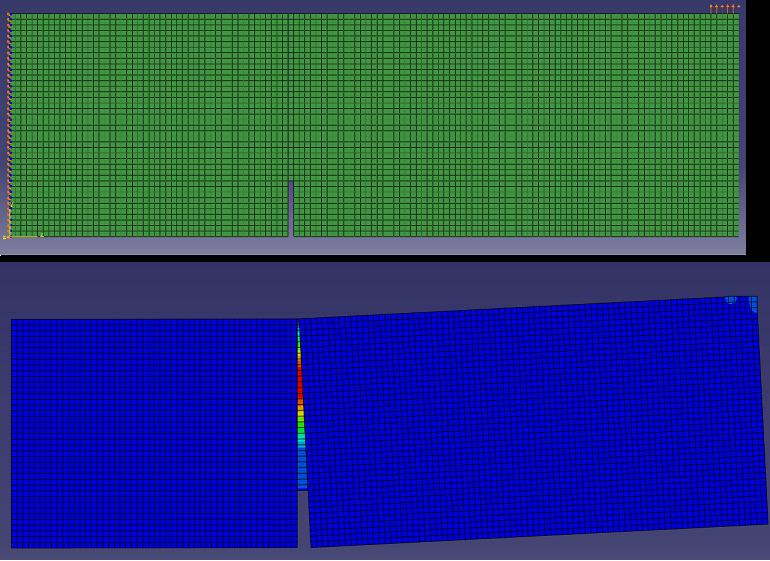
My model is looking like this now. But I don't know what's wrong. It
seems taht the whole force/displacement is lost in the cohesive zone.
If somebody can help that would be very nice
here the pic: http://f.666kb.com/i/bnody4selpc6iml9m.jpg
Thanks for advance
Hello,
(for completing R. Huang's post : node/7396).
A few years ago, some colleages (from Italy, UK and Brazil) and I proposed some comparisons of the behavior of cohesize zone models. This was presented during ECCM 2004. The paper is attached.
Hello,
I'd like to ask if anybody knows if it is possible to use an ABAQUS usersubroutine that could vary some parameters (τmax, kn or ks etc) of the cohesive zone model of ABAQUS with the vertical pressure applied on the interface. The new ability of ABAQUS to support cohesive behaviour in contact surfaces seems very interesting and useful, however how could somebody simulate the interface under a compression - shear regime that may follow a Mohr-Coulomb type behaviour?
Dear all,
I am trying to simulate a three-laminated composite considering the cohesive effect between the interfaces.
How can I implement this in COMSOL? Are there any Samples to follow?
Thanks!
Binglun
Hi,
I am using cohesive elements to model the interface around a
circular inclusion. First I used Abaqus/standard I got proper results
but when I used same values with an amplitude curve (tabular, linearly
applied) to apply load quasi-statically in Abaqus/Explicit, I could not get a converged
solution. Field variables are oscillating and elements getting
distorted excessively. In Abaqus/Explicit I am applying load very
slowly but even though same problem persists.
Regards
Gouse
Help! imechanica!
This might not be a smart question to ask, but if any of you can help me, it'd be great.
I have a DCB (sandwitch specimen) with a cohesive element in the middle. Studying pure Mode I case, displacement is applied at the end of the DCB. Cohesive element works great (it fails when one reaches max separations). But I am having a difficulity in extracting crack length (i.e. length of failed cohesive element) vs time step. I looked for Damage and Status commend, but it's not promising. (I'm pretty new to ABAQUS....)